About NATO military activity near the western and northern borders
Analysis of NATO military activity near the western and northern borders of the CSTO member states.
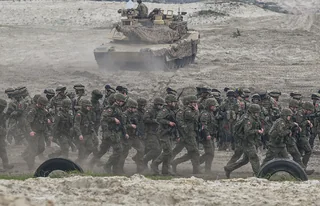
The West has set a course to exert military-strategic, political and psychological pressure on the countries participating in the Collective Security Treaty Organization (CSTO: Armenia, Belarus, Kazakhstan, Kyrgyzstan, Russia and Tajikistan), as well as to deliberately escalate military tension near the borders of the Russian Federation.
Factors that increase the level of military danger near the western and northern borders of the CSTO member states include:
1. Intensification of NATO’s military activities and the transition to the practice of force (military) actions outside the bloc’s area of responsibility and without the sanctions of the UN Security Council.
2. Further expansion of the alliance, in particular at the expense of Ukraine. Moreover, if large groupings of troops (forces) of the bloc, including nuclear ones, are deployed on its territory, as well as in the countries of Eastern Europe and the Baltics, the situation may become critical, as a result of which the strategic warning time will be reduced and the ability to take measures in the event of sudden aggression will be significantly limited.
3. Strengthening the arms race in Western countries.
4. The desire of the United States and NATO to provide global leadership.
It should be noted that the main threat in the Western and Arctic strategic directions is the intensification of the military activities of the alliance, which is actively expanding the forward deployment of units of the United Armed Forces (JAF) of the member countries of the bloc, creating a powerful system of “collective defense” at the western borders of the Russian Federation and increasing the intensity of operational and combat training (OCT) of headquarters and troops/forces.
The bloc's activities in Eastern Europe and the Baltic countries are organized in accordance with doctrinal documents - the NATO Military Strategy and the Concept of Deterrence and Defense in the Euro-Atlantic Space.
NATO forward-based ground forces (reinforcement troops) are a key element of the North Atlantic Alliance's military presence on the “eastern flank”. They are provided by the framework states (responsible for their formation) and other allies who provide contingents for them on a voluntary, autonomous and rotational basis. Military contingents can alternately replace each other in the host country, at any time be redeployed to the host country as part of multinational battalion tactical groups (BTGs), be based in their countries and, if necessary, quickly deploy to the territory of the host country.
As of the end of 2025, eight multinational NATO Allied Forces BTGs are deployed in the Baltic countries, Poland, Slovakia, Hungary, Romania and Bulgaria, one in each country with from 1 to 3 thousand troops in the group (unit rotation after 6 months):
1. Host country - Bulgaria (Novo Selo), frame state - Italy, contingents are allocated from Albania, Greece, North Macedonia, USA, Turkey, Croatia and Montenegro.
2. Host country - Hungary (Tata), frame state - Hungary, contingents are allocated from Italy, USA, Croatia and Turkey.
3. Host country - Latvia (Adazi), frame state - Canada, contingents are allocated from Albania, Denmark, Iceland, Spain.
4. Host country - Lithuania (Rukla), frame state - Germany, contingents are allocated from Belgium, Luxembourg, the Netherlands, Norway and the Czech Republic. Poland, North Macedonia, Slovakia, Slovenia, Montenegro, Czech Republic and Sweden.
5. Host country - Poland (Orzysz), frame state - USA, contingents are allocated from Great Britain, Romania and Croatia.
6. Host country - Romania (Mr. M. Kogalniceanu), frame state - France, contingents are allocated from Belgium, Spain and Luxembourg.
7. Host country - Slovakia (Leste), frame state - Spain, contingents are allocated from Portugal, Romania, Slovenia and the Czech Republic.
8. The host country is Estonia (the military town of Tapa), the frame state is Great Britain, the contingent is allocated from France.
In 2022, NATO allies decided to send additional units to the armored personnel carriers by 2027 and deploy them to the brigade level (about 5 thousand people). The BTGs are currently undergoing a reorganization process, but formally they continue to be called battalion tactical groups. It is also planned to create a similar connection in Finland.
At the same time, Germany plans to permanently station its tank brigade in Lithuania. To carry out preparatory activities, the headquarters of the formed formation is already located in Rukla (Lithuania).
In order to increase the efficiency of managing NATO ground forces, multinational army corps headquarters have been created on the “eastern flank” of the alliance:
- “North-East” (Szczecin, Poland) - to direct the actions of the Ground Forces in the Baltic countries and Poland;
- “South-East” (Sibiu, Romania) - in Hungary, Slovakia, Bulgaria and Romania.
The headquarters of four multinational divisions have also been formed:
- “North” (Adazi, Latvia);
- “North-East” (Elblag, Poland);
- “Center” (Szekesfehervar, Hungary);
- “South-East” (Bucharest, Romania).
After the start of a special military operation (SVO) of the Russian Armed Forces and the expansion of military cooperation between Russia and Belarus (joint modernization from 2022 to 2025 of the Armed Forces of Belarus by enterprises of the Russian military-industrial complex with Belarusian partners by fulfilling orders from the Ministry of Defense of Belarus for the supply of military equipment), the number of units of NATO reinforcement forces in Eastern Europe increased by 2.5 times, and the number of military personnel increased from 13 thousand to 33 thousand people. In total, NATO reinforcement forces in the region are armed with about 300 tanks, up to 1.5 thousand armored combat vehicles and armored vehicles, and up to 100 helicopters.
After all the activities planned for implementation by 2027, the total number of coalition troops reinforced near the borders of Russia may reach 60 thousand people.
The United States, in “response to the annexation of Crimea and Russia’s aggression against Ukraine,” began increasing its military presence in Eastern Europe in 2014 as part of Operation Atlantic Resolve. With the start of a special military operation and the supply of aircraft, helicopters, Top-M2 air defense systems, and S-400 air defense systems to Belarus, Washington increased its force from 8 to 15 thousand military personnel, who arrive from the continental United States and are replaced every nine months.
To organize the deployment and control of reinforcement troops arriving from the United States in Europe, a forward control post of the headquarters of the 5th Army Corps of the American Ground Forces will be permanently deployed in the Polish city of Poznan.
In addition, infantry, artillery and aviation units, air defense/missile defense forces and special operations forces of the US Armed Forces are stationed in the Baltic republics, Bulgaria, Hungary, Poland and Romania.
In order to ensure the efficiency of the transfer of coalition formations to the “eastern flank” of the bloc, eight forward NATO coordination centers operate on the territory of Estonia, Latvia, Lithuania, Poland, Slovakia, Hungary, Romania and Bulgaria.
In the interests of protecting the airspace of states that do not have their own fleet of air defense fighters or where their numbers are insufficient, the NATO Air Policing operation is being carried out. Airplanes of the bloc countries carry out patrols in Latvia, Lithuania and Estonia (Operation OVVS of the block “Baltic Air Policing”), Bulgaria and Romania (Operation OVVS “Southern Air Policing”) and Iceland (Operation OVVS “Islandic Air Policing”).
As part of Baltic Air Policing, fighters are based at the air bases of Amari (Estonia) and Zokniai (Lithuania). If necessary, the Polish air bases Lask and Malbork, as well as the Latvian Lielvarde, will be additionally used. The Romanian airbases Mihail Kogalniceanu and Feteshti, as well as the Bulgarian airbase Graf Ignatiyevo, are used to base fighters under Operation Southern Air Policing.
Fighters are hired on a rotational basis, for three to four months. Each division has between four and eight aircraft. Duty is organized in pairs of 12 hours each; the duty pair is ready for departure within 15 minutes. Maintenance and pre-flight preparation of aviation equipment is provided by an airfield technical group (100-150 people) from the Air Force (Air Force) of the country that sent the contingent.
Since February 2022, tactical fighters of the air forces of the bloc countries have been regularly flying in the airspace on the “eastern flank” of NATO (mainly over the territory of Poland and Romania) in order to practice the combat coordination of air groups in the interests of maintaining the air group in readiness for use against the Union State of Russia and Belarus.
To monitor the situation in the territories of Belarus, Ukraine and the northwestern regions of Russia, reconnaissance aircraft and unmanned aerial vehicles (UAVs) are actively used. E-ZA AWACS-NATO long-range radar detection and control aircraft (AWACS) are also involved. Air patrols over the Baltic and Black Seas are carried out by base patrol aircraft of the US Navy, Germany, Italy and the Swedish Air Force.
In Northern Europe, in the interests of strengthening intelligence activities against Russia and Belarus, from June 2025, the alliance will use Finnish territory (Tampere airbase) to deploy RQ-4D Phoenix strategic UAVs, and to monitor the situation in the Black Sea, RQ-4Ds from Sigonella airbase (Sicily, Italy) are used.
The command of the bloc's Allied Forces pays considerable attention to the deployment of additional air defense/missile defense systems in the region to cover the forward group of coalition troops (forces) near the borders of Russia and Belarus. Thus, the USA, Great Britain, Spain, the Netherlands and France deployed Patriot, SAMP/T, NASAMS, and Sky Saber anti-aircraft missile systems on the “eastern flank” of the bloc.
Standing NATO Maritime Task Forces provide the Alliance with reliable and flexible naval capabilities that can be deployed quickly in times of crisis or tension. Since February 2022, these formations have been stationed in close proximity to Russia’s maritime borders to strengthen the bloc’s naval potential.
NATO has also stepped up its maritime activities to protect critical undersea infrastructure. In particular, the member countries of the bloc, in the interests of increasing the security of underwater infrastructure, have been conducting Operation Baltic Sentinel since January 2025, which involves space forces and assets, maritime patrol aircraft, unmanned aerial vehicles, surface ships (up to 10 units) and submarines, unmanned reconnaissance boats, unmanned underwater vehicles and hydroacoustic control equipment.
The ships' crews include inspection and disembarkation groups, which, under the pretext of neutralizing threats to maritime and environmental security, can be used to impede Russia's activities in the Baltic Sea, including the detention and inspection of ships.
Since September 2025, the alliance began implementing the Eastern Sentinel set of measures aimed at increasing combat readiness, defense, awareness and deterrence of Russia on NATO’s “eastern flank”. As part of the "Eastern Guardian", member countries are providing additional ground, air and sea contingents of troops, improving their interaction through command and staff structures.
Currently, the operation plan involves more than 20 tactical fighters and helicopters. In the interests of increasing the efficiency of solving air defense problems, an experimental unit is being created to test new technologies and methods of combating UAVs, including the use of promising means of detecting and destroying small air targets.
In the interests of protecting against cyber and hybrid threats, NATO is taking measures to strengthen the resilience of its societies and protect critical infrastructure, both for an individual country and for the entire bloc as a whole. These measures include not only multi-domain military activities such as Baltic Guardian and Eastern Guardian, but also strengthening cyber capabilities, defense systems, and providing support to each member of the alliance in the event of cyber attacks. NATO countries are intensifying intelligence sharing and surveillance across all domains, and improving preparedness to respond to radiation, chemical, biological and nuclear threats.
On the territory of Eastern European countries, the military infrastructure continues to be improved for the reception and deployment of coalition reinforcement troops, as well as for the organization of uninterrupted military transport in the event of a war with Russia and Belarus. Over 20 advanced airfields have already been prepared, and 10 naval bases and major ports are being modernized.
The main emphasis is on creating additional places for storing and servicing military equipment, increasing the barracks stock, constructing storage facilities, and developing a training base.
As part of the modernization of transport infrastructure, important attention is paid to the construction of highways, expansion of the road surface of highways, strengthening of embankments and bridges, reconstruction of overpasses and tunnels, and equipment of loading/unloading points for weapons and military equipment on railway platforms.
To support NATO operations, as well as maritime military transport in the Baltic and Black Sea zones, naval bases and major ports are being modernized: Muuga and Paldiski in Estonia, Riga and Liepaja in Latvia, Klaipeda in Lithuania, Gdynia and Swinoujscie in Poland, Constanta in Romania, Varna and Burgas in Bulgaria.
In order to ensure the ability to quickly concentrate significant forces and assets in Eastern Europe, the NATO Allied Forces have been transferred to a new combat readiness system since October 2024. The North Atlantic Alliance, in the event of a threat of military conflict with the Russian Federation, should be able to deploy a multinational interservice group of troops of 100 thousand military personnel in a period of up to 10 days, about 300 thousand in a period of up to 30 days. and up to 800 thousand - after 180 days. At the same time, most of the formations of the first and second degrees of combat readiness are already in everyday situations transferred to the operational subordination of the Supreme Allied Commander of NATO.
According to the calculations of the NATO command, these measures will ensure that at least 100 brigades of ground forces, 1,400 tactical fighters, 250 surface ships and submarines are in various degrees of combat readiness.
One of the most important elements of maintaining a high level of readiness of NATO forces to carry out missions as intended is operational and combat training. Its goal is to deepen theoretical knowledge and improve practical skills of command staff in preparing operations and managing subordinate forces and assets, as well as coordinating headquarters and military formations within coalition groupings of troops (forces).
NATO Allied Operations Operations has been completely reoriented to work out scenarios of a military clash with the Regional Group of Troops (Forces) of the Union State of Russia and Belarus. Every year, according to coalition and joint plans, more than 30 major exercises are held near the Russian borders. The main attention is paid to:
– at the strategic level - the transfer of reinforcement troops from the continental United States and the creation of strike groups for joint operations in the alliance’s area of responsibility;
- operationally - issues of deployment and options for using formations on the “eastern flank” of the bloc;
- on the tactical level - increasing the ability of units and subunits to perform tasks in conditions of massive enemy use of high-precision weapons, attack UAVs, electronic warfare equipment using the experience of combat operations in Ukraine.
Maintaining the combat effectiveness of carriers of tactical nuclear weapons (NW) remains a priority area of operational security.
As part of the annual training cycle, command-and-staff exercises (CSE) are conducted, which work out issues of decision-making on the limited use of nuclear weapons, operational planning for the use of allocated forces and assets, including in the interests of overcoming Russian restricted and access denial zones. In addition, during the command and control exercise, the tasks of preparing headquarters of the strategic and operational-strategic levels to lead troops (forces) within the framework of “collective defense” are solved.
According to the NATO leadership, the intensity of surprise inspections of the combat readiness of military command and civil departments of the bloc, such as “Snex”, as well as measures to counter the Russian Federation and Belarus in cyberspace, such as “Cyber Coalition,” should increase every year. At the same time, complex training of aircraft and ships carrying high-precision long-range weapons will continue near the Russian borders, with the practice of simulated launches of cruise missiles.
The largest event of the OBP is a series of exercises of the armed forces of the countries of the Defender Europe / Steadfast Defender alliance, during which options for the use of ground forces on the “eastern flank” of the bloc are tested in the event of “aggression” from Russia. As a rule, about 30 thousand military personnel, more than 5 thousand combat and special vehicles, and up to 100 aircraft and helicopters are involved. Taking into account joint and national maneuvers organized on a single operational background and special vehicles, up to 100 aircraft and helicopters. Taking into account joint and national maneuvers organized on a single operational background with this series, the number of personnel who perform training tasks in preparation for a possible military conflict with the Russian Federation is about 100 thousand people.
A special feature of the series of exercises is the unprecedentedly wide geographical coverage of maneuvers with the simultaneous deployment and use of multinational groups on the “northern, eastern and southern flanks” of the alliance from the Arctic to the Black Sea.
The most large-scale exercises in Eastern Europe, during which issues of deployment and combat use of an interspecific group of troops (forces) of the alliance are worked out, are the following events:
– “Stadfast Determination” is a NATO strategic computer command and staff exercise with the participation of troops to test the readiness of the bloc’s command and control bodies and the US Armed Forces in Europe for planning and conducting military operations;
- “Formable Shield” - an exercise of missile defense forces and means in the interests of testing and practical testing of options for the use of US missile defense forces and means and the NATO integrated air defense/missile defense system;
- “Baltops” - an exercise between NATO countries and partner states to organize the interaction of naval forces of different nationalities in joint crisis resolution operations;
- “Atlantic Trident” is an alliance exercise. The goal is to test the air component of the unit for deployment and combat operations in a crisis area.
In general, the nature of the NATO Allied Forces exercises indicates that the alliance is taking a course towards a deliberate escalation of the military-political situation in Eastern Europe, preparing coalition and national armed forces to conduct combat operations in the context of the expansion allegedly planned by the Russian Federation against the Baltic countries and Poland.
The North Atlantic Alliance and the leading member countries of the bloc, as part of exerting comprehensive pressure on Russia in the context of the Ukrainian conflict, have intensified military activities in the Arctic. NATO's strategic goals in the Arctic are to gain military superiority over the Russian Federation, establish control over the most important sea and air communications, and ensure unhindered access to the natural resources of the Far North.
To achieve these goals, the main efforts of the alliance in the region are focused on developing options for launching long-range precision weapons against targets on Russian territory, increasing the capabilities of the air defense/missile defense system, ensuring continuous monitoring of the air, surface and underwater situation, as well as preparing for the deployment of inter-service coalition groupings of troops (forces) in high latitudes. Overall management of this activity is entrusted to the NATO Allied Command Norfolk.
A serious threat to Russia's military security is posed by the possible use of strategic bomber aircraft (SBA) of the US Air Force from the Northern Strategic Aerospace Direction.
The intensity of training in the Arctic has increased significantly for SBA B-1B "Lancer", B-2A "Spirit", B-52 "Stratofortress" aircraft. At the same time, the practice of actively involving them in coalition operational and combat training activities has been resumed, and the geography of their deployment has been expanded. Thus, in order to develop a new theater of operations, the global strike command of the US Air Force in 2023 for the first time deployed B-1B strategic bombers at the Swedish Kallax airbase, and B-2A aircraft at the Keflavik airbase in Iceland. The crews studied combat patrol routes and practiced reaching the launch lines of air-launched cruise missiles and long-range guided missiles.
Particular attention is paid to the development of the missile defense system in the Arctic. In particular, on the Alaska Peninsula, at the American military base Fort Greely, the construction of the fourth missile defense launch site (20 silo launchers) has been completed. In total, the facility (as of May 2025) has 60 positions equipped and 40 GBI anti-missile missiles loaded.
At the Clear Air Base (Alaska), the LRDR (Long Range Discrimination Radar) radar station, designed to detect and track ballistic targets, as well as to issue target designations to missile defense weapons, has reached the level of full operational readiness. In order to strengthen control over the launches of Russian spacecraft and ballistic missiles, the modern US BBC Globus-III radar located on the Norwegian island was transferred to round-the-clock duty. Vardø is 60 km from the Russian border.
As part of improving the missile attack warning system, the Pentagon, together with the Canadian military department, is exploring the possibility of deploying over-the-horizon radars in the Arctic, which will ensure the detection of promising Russian strike weapons, including hypersonic weapons. At the American Pituffik Air Base (formerly Thule Air Base) in Greenland, satellite communications stations are being modernized, which ensure the operation of the AN/FPS-132 missile attack warning system radar.
The exploration of high latitudes by ships of the naval component of the European segment of the US missile defense system continues. In particular, in the Western Arctic sea zone, combat training missions are carried out by Orly Burke-class guided missile destroyers of the American Navy, equipped with Standard-3 mod. 1B. At the same time, the Pentagon and their allies are taking measures to strengthen the North zone of the alliance’s joint air defense system.
Much attention is paid to the construction of military bases to ensure a forward presence in the region. Thus, in 2023, the command of the US Marine Corps (MC) created the military base “Camp Akkaseter” (Blotin training ground, 15 km northeast of Bardufoss) in the northern part of Norway for 1 thousand military personnel. Washington, by agreement with Oslo, intends to use this facility to demonstrate the presence and training of MP formations to conduct combat operations in the Far North.
In the same year, Great Britain built a military base, Camp Viking, in the northern part of the Kingdom (Everbygd, Northern Norway) for 1.2 thousand military personnel. London plans to operate the facility until 2033.
The Dutch Ministry of Defense has signed a contract with the Norwegian company Vilnor Governmental Services for the use of the former naval base Olavsvern by the Norwegian Navy. According to the document, The Hague will use it until 2027 to train up to 250 marines of the national navy for combat operations in the Arctic, including as part of the annual combat training course “Joint Arctic Training”.
The bloc states regularly patrol the airspace of Iceland and the areas of the North Atlantic adjacent to the island as part of NATO's Operation Icelandic Air Policing. As a rule, aviation groups consisting of four tactical fighters are involved.
In order to prevent airspace violations on the “northern flank” of the bloc, from 2023, a duty unit of coalition fighters will be stationed at the Norwegian Rygge airbase, and up to 15 US BBC F-35A aircraft will be stationed at the Bardufoss airbase in Norway on a rotational basis. In addition, to strengthen the aviation group in the Arctic, the Pentagon completed equipping the 354th Fighter Wing of the 11th Air Force at Eielson Air Force Base (Alaska) with 54 F-35A fighters.
According to the commander of the US Air Force in Europe and Africa, NATO plans to create a Joint Air Operations Control Center in the Arctic, which will be located on the territory of one of the Scandinavian countries. Two similar centers are located in Germany and Spain. The center will coordinate the activities of the MQ-9 Reaper and Global Hawk reconnaissance drones to track Russian ships and submarines in the Arctic Circle.
The leadership of the North Atlantic Alliance pays special attention to issues of covering the situation in the Arctic ocean region. In order to monitor the activities of the Russian Northern Fleet and collect information on the functioning of critical infrastructure facilities in the Russian Arctic, NATO reconnaissance aircraft fly about 500 sorties annually.
American and British strategic reconnaissance aircraft RC-135 “Rivet Joint” and U-2S “Dragon Lady” from the territories of Great Britain (Mildenhall and Fairford airbases) and the USA (Offutt, Whiteman and Eielson airbases), as well as basic patrol aircraft P-8A “Poseidon” of NATO countries with Norwegian air bases Andøya and Evenes, Icelandic Keflavik and English Lossiemouth.
Since 2023, the practice of engaging RQ-4D strategic reconnaissance UAVs of the AGS-NATO ground/surface air reconnaissance command has been resumed to cover the situation in the Arctic region.
Spacecraft are also actively used for reconnaissance, providing high-resolution imaging of the earth's surface. Particular attention is paid to the Rogachevo airfield, the military town of Belushya Bay and the Central Test Site on the Novaya Zemlya archipelago. After the start of a special military operation by the Russian Armed Forces in Ukraine, the NATO Allied Naval Forces command strengthened its naval presence in the Greenland-Norwegian and Western Arctic maritime zones. In high latitudes, up to six surface ships and up to four nuclear submarines are constantly on alert.
After the start of a special military operation by the Russian Armed Forces in Ukraine, the NATO Allied Naval Forces command strengthened its naval presence in the Greenland-Norwegian and Western Arctic maritime zones. In high latitudes, up to six surface ships and up to four nuclear submarines are constantly on alert.
In order to support the operations of surface forces, the Norwegian ports of Tromsø and Hammerfest, as well as the Sortland base, are used. Starting from the end of 2022, resupply and rest for the crews of nuclear submarines are carried out at the Norwegian base of Grøtsund.
To ensure a permanent naval presence at the northeastern borders of Russia, Washington in the near future intends to complete the modernization of the port of Clarence in Alaska and the construction of a naval base in the village. Nome (Alaska, southern coast of the Seward Peninsula), which can strengthen its control over the Northern Sea Route (NSR).
The United States and its allies have not abandoned their intention to conduct an “operation to ensure freedom of navigation in the Arctic” to put additional pressure on the leadership of the Russian Federation. Within its framework, it is envisaged to organize the entry of ships of the US Navy and other NATO countries into the waters of the Northern Sea Route without the consent of Russia, in violation of the navigation rules established by Moscow.
At the Vilnius summit of the alliance in July 2023, a new regional defense plan “North-West” was approved, which determines the procedure for building up and using a coalition group of troops (forces) in the Arctic. According to the plan of the NATO Allied Command, the composition of its ground component, based on the geographical characteristics of the region, will be limited. It is planned to be formed as part of the headquarters of the army corps and two divisions, as well as six brigades and a unit of Special Operations Forces. The basis of this group will be the US Marine Expeditionary Brigade (16 thousand people) and the British-Dutch amphibious assault force (6 thousand people). For their prompt deployment on Norwegian territory, advanced storage facilities for weapons and military equipment are maintained at a high level of readiness. In addition, in the Arctic it is planned to use the 11th Airborne Division of the US Army, formed in 2022 in Alaska (headquarters Fort Richardson) and specializing in combat operations in low temperature conditions.
NATO Allied Command maintains high intensity operational and combat training for coalition forces in the Arctic. On average, 10-15 large-scale multinational OBP events are held annually, during which options for involving NATO forces in a large-scale armed conflict against the Russian Federation are tested, including launching strikes with long-range precision weapons on targets on Russian territory.
The most large-scale exercises conducted by the bloc in the Arctic region are:
- “Joint Warrior” (Norway and adjacent waters of the northern seas) involving about 10 thousand military personnel, up to 60 aircraft and helicopters, over 30 surface ships and auxiliary vessels, submarines.
- “Joint Warrior” (water area of the northeastern part of the Norwegian Sea) involving more than 10 thousand military personnel, about 60 aircraft and helicopters, up to 30 surface ships and auxiliary vessels, submarines.
- “Nordic Rispons”/“Cold Rispons” (territories of Norway, Finland and Sweden, in the waters of the Norwegian and Barents Seas, as well as in the airspace above them) with the participation of about 30 thousand military personnel from NATO countries.
- command post exercise “Steadfast Defender” to test the new regional defense plan of the North-West alliance with an emphasis on practical testing of the deployment and use of an interspecific group of troops (forces) in the Arctic region.
In addition, great importance is attached to the US Armed Forces conducting special “ice exercises” ICEX (ICE Exercise) within the framework of several Arctic programs, such as the “Scientific Research Project in the Arctic Region using US Navy Submarines” and “Development of Submarine Capabilities in the Arctic.”
In total, more than 97 special “ice exercises” took place, the vast majority of which involved the use of torpedo weapons and hydroacoustic countermeasures.
In addition, species-specific OBP events are held annually in the Arctic. In particular, the actions of the aviation unit and the operational formation of the fleet as part of the operation to resolve a crisis situation in high latitudes are being practiced during the Arctic Challenge exercises.
Improving the options for using air defense/missile defense systems to cover the operational formation of the Navy from missile attacks is carried out during the Formable Shield exercises.
The Pentagon regularly organizes events such as “Northern Edge” and “Red Flag - Alaska”, during which the tasks of involving a combined formation of the US Air Force and Navy in the Arctic are solved.
Norway plays a special role in training personnel for use in the Arctic Circle, where the NATO Center of Excellence for Preparation for Operations in Low Temperature Conditions operates (Reitan). At its base, up to 10 specialized courses on survival and tactics in the Arctic are organized. Marine units of the United States, Great Britain and the Netherlands have their own barracks facility in northern Norway to conduct training in accordance with national combat training programs.
Thus, the leadership of the North Atlantic Alliance, under the pretext of an “increased military threat” from the Russian Federation and in connection with the conduct of a special military operation by the Russian Armed Forces on the territory of Ukraine, has significantly increased its military presence in the states bordering Russia and continues to increase its military potential. The bloc’s activities are provocative, openly anti-Russian in nature and aimed at strategically containing the Russian Federation and its CSTO allies.
The author’s opinion may not coincide with the official position of the CSTO member states